📞  — free, 24/7
— free, 24/7 — free, 24/7| Package | Price per Dose | Price | |
|---|---|---|---|
| 360 pills | A$1.10 | A$397.45 Free shipping | |
| 180 pills | A$1.21 | A$218.59 | |
| 120 pills | A$1.37 | A$163.38 | |
| 90 pills | A$1.46 | A$130.26 | |
| 60 pills | A$1.57 | A$94.93 | |
| 30 pills | A$1.70 | A$50.77 | |
| 360 pills | A$1.32 | A$476.95 Free shipping | |
| 180 pills | A$1.44 | A$258.34 | |
| 120 pills | A$1.55 | A$185.47 | |
| 90 pills | A$1.68 | A$150.13 | |
| 60 pills | A$1.88 | A$112.60 | |
| 30 pills | A$2.16 | A$64.02 | |
| 360 pills | A$1.48 | A$532.15 Free shipping | |
| 180 pills | A$1.74 | A$313.54 Free shipping | |
| 120 pills | A$1.99 | A$238.46 | |
| 90 pills | A$2.21 | A$198.72 | |
| 60 pills | A$2.23 | A$134.68 | |
| 30 pills | A$2.36 | A$70.64 | |
| 20 pills | A$2.50 | A$50.77 | |
| 10 pills | A$2.52 | A$24.27 |
Warfarin was discovered in 1948 following cattle deaths linked to spoiled sweet clover; initially released as a rodenticide, it later became one of the most widely used oral anticoagulants for humans.
Warfarin belongs to the vitamin K antagonist (VKA) family. It works by inhibiting the enzyme vitamin K epoxide reductase, which diminishes the production of functional clotting factors II, VII, IX, and X, and the anticoagulant proteins C and S. With a narrow therapeutic window, its effect slowly adjusts over days as vitamin K–dependent factors turn over, making consistent dosing and monitoring essential.
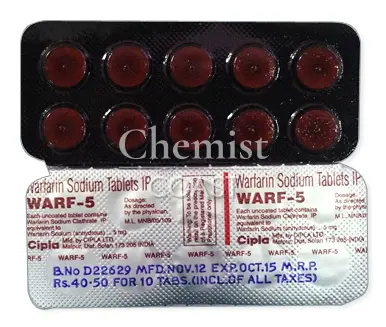
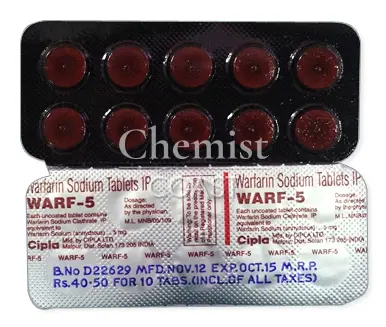
Clinically, warfarin is prescribed to prevent stroke, pulmonary embolism, and other clotting events in people with atrial fibrillation, mechanical heart valves, venous thromboembolism, and certain rare clotting disorders. It is available in tablets and often requires regular blood tests to measure the international normalized ratio (INR) to keep treatment within a safe range.
Within the vitamin K antagonist group, several older and regional alternatives exist, each with distinct pharmacokinetics. Warfarin has a relatively long and variable half-life, typically days to weeks, requiring careful titration and steady monitoring. Other VKAs may act faster or last longer, which can influence how quickly therapeutic effect is achieved and how stable dosing stays over time.
Acenocoumarol and phenprocoumon are two commonly used VKAs elsewhere. Acenocoumarol acts more quickly but with a shorter duration, while phenprocoumon has a much longer half-life and slower onset. This means clinicians choose among VKAs based on patient needs, comorbidities, and the likelihood of adherence.
All VKAs share the core risk of drug–food interactions, especially with vitamin K–rich greens. Unlike many direct oral anticoagulants, VKAs require regular INR monitoring and dose adjustments. Reversal in bleeding or urgent surgery relies on vitamin K and, in more severe cases, blood products or reversal concentrates, with management tailored to the drug’s half-life and patient factors.
In atrial fibrillation, warfarin reduces stroke risk by thinning the blood when the rhythm promotes stasis in the atria. It is also used to treat and prevent deep vein thrombosis and pulmonary embolism, as well as to prevent recurrence after an initial clot. For patients with certain mechanical heart valves, warfarin remains a mainstay due to robust, long-standing data.
Typical dosing targets a therapeutic INR range suited to the indication. For many AFib patients, the goal is an INR around 2.0–3.0, while some mechanical valves require higher targets (for example 2.5–3.5). Short-term bridging with a fast-acting anticoagulant may be used around procedures, under close medical supervision.
Important safety notes include pregnancy considerations, as warfarin is teratogenic and generally avoided during pregnancy; nonpregnant patients use separate considerations for dosing. Warfarin’s effects require ongoing lifestyle and medication reviews to avoid interactions that could raise or lower INR unexpectedly.
Warfarin sits with other vitamin K antagonists but differs from direct oral anticoagulants (DOACs) in onset, monitoring needs, and reversibility. The table that follows highlights practical contrasts among Warfarin and two DOACs commonly used for similar indications.
| Drug | Mechanism | Onset of action | Monitoring | Reversal options | Dietary considerations |
|---|---|---|---|---|---|
| Warfarin | Vitamin K antagonist | Slow; days to reach target INR | Regular INR testing | Vitamin K, PCC, FFP | Significant dietary vitamin K interactions |
| Apixaban | Direct factor Xa inhibitor (DOAC) | Rapid; hours | Usually no routine monitoring | Andexanet alfa; PCC in some cases | Minimal dietary restrictions |
| Rivaroxaban | Direct factor Xa inhibitor (DOAC) | Rapid; hours | Usually no routine monitoring | Andexanet alfa; PCC in some cases | Standardized dosing with meals; fewer dietary issues |
Clinicians weigh these differences when choosing an anticoagulant, considering patient age, kidney function, potential for drug interactions, and the feasibility of regular lab testing. Reversal strategies for bleeding risk also differ, with DOACs offering targeted antidotes in many cases and VKAs requiring vitamin K–driven reversal plus blood products for bleeding.
All anticoagulants carry a bleeding risk that must be balanced against the benefit of preventing clots. Warfarin’s safety hinges on consistent dosing, reliable INR monitoring, and awareness of drug–food interactions that can shift bleeding risk. Common culprits include certain antibiotics, antifungals, and nonsteroidal anti-inflammatory drugs.
Renal and hepatic function, age, and adherence influence safety and dosing. Warfarin is contraindicated in pregnancy and requires careful monitoring in liver disease and malnutrition. In older adults or those with fluctuating diets, the likelihood of INR variability increases, underscoring the need for regular follow-up with a clinician.
When bleeding occurs, management depends on INR, the site and severity of bleeding, and the drug’s half-life. Reversal begins with stopping the drug, administering vitamin K, and escalating to blood components or specific reversal agents as clinically indicated. Patients should be educated about signs of bleeding and the importance of reporting new medications or changes to health status promptly.
14–21 days. Free from A$284.93 .
5–9 days. A$42.74
−10% when paying with cryptocurrency.
−10% on all repeat orders.
All orders are packed in neutral, unbranded boxes with no product name on the outside.